Seamless gutter installation for Portland homes
Seamless aluminum gutters formed on site to fit your Portland home, sized for our long rainy season and fitted with downspouts that move water away from the foundation.
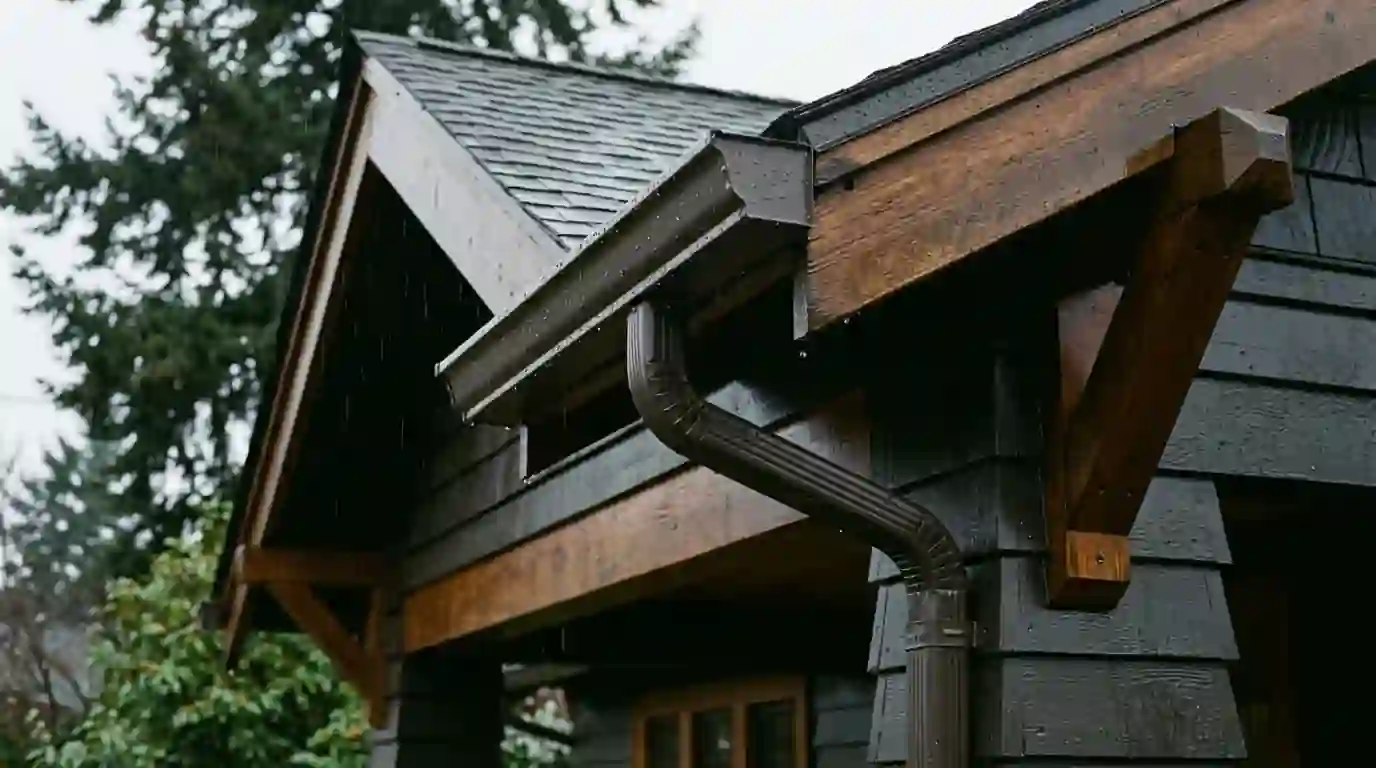
Seamless gutter installation in Portland means forming aluminum gutters on site from a coil, cut to the exact length of each roof edge so there are no joints along the run. Most homes get 5 inch K-style gutters, while large or steep roofs and tree-heavy lots do better with 6 inch gutters and 3 by 4 inch downspouts that handle heavy rain and fir needles.
Gutters do one job: take the water your roof collects and put it somewhere harmless. In Portland that is a lot of water, month after month, and old sectional gutters with a joint every ten feet start dripping at each seam long before the metal wears out. Seamless gutters remove most of those joints, so the only seams left are at the corners and the end caps.
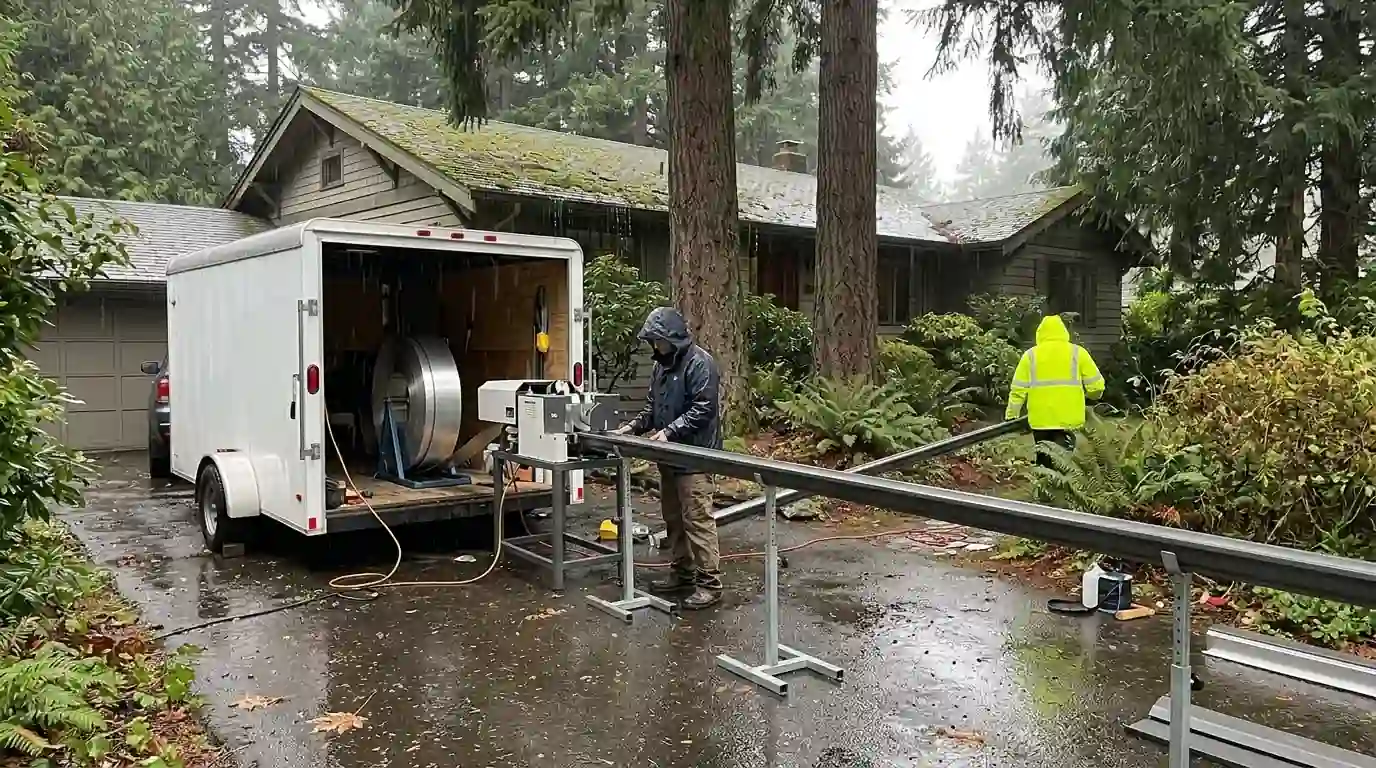
We bring a forming machine to the house and run the gutters from a coil of painted aluminum, cutting each piece to the length of the roof edge. That way a forty foot eave gets one forty foot gutter. We hang it on hidden hangers screwed into the fascia, pitch it toward the outlets and connect downspouts sized for the roof area they serve.
Getting the size right matters as much as the material. A gutter that is too small for a steep roof will overshoot or overflow in a downpour, and a downspout that is too narrow will plug with needles. We measure the roof area and pitch draining to each run before choosing gutter and downspout sizes.
Which gutter size and style fits your house?
Most Portland homes fall into one of these setups.
5 inch K-style aluminum
The standard size for most single story and modest two story homes with average pitch. It handles typical Portland rain well when paired with enough downspouts and kept reasonably clear of debris.
6 inch K-style aluminum
Carries roughly forty percent more water than 5 inch. We recommend it for steep roofs, large roof areas, valleys that dump into one spot and homes under heavy tree cover where debris slows flow.
2 by 3 inch downspouts
Standard downspouts that work for smaller roof areas on 5 inch systems. They are less visible on the house but plug more easily with fir needles and maple seeds.
3 by 4 inch downspouts
Larger downspouts that move more water and pass needles and leaves with fewer clogs. Paired with 6 inch gutters or used on 5 inch runs that serve big roof sections.
Is it time to replace your gutters?
These signs usually mean new gutters will serve you better than more repairs.
Drips at every sectional joint
Older sectional gutters leak at their joints as the sealant ages. When you see a line of drips along the eave during rain, resealing buys a season at best, and new seamless gutters solve the problem.
Water spilling over in heavy rain
If clean gutters still overflow during downpours, they are probably too small for the roof area or too few downspouts are carrying the load. Upsizing to 6 inch or adding outlets fixes the root cause.
Gutters pulling away from fascia
Old spike and ferrule hangers loosen as the wood around them softens. When a gutter tips forward or gaps open between gutter and fascia, water runs behind it and rots the trim.
Rot along the fascia boards
Soft or peeling fascia behind the gutters is a sign water has been getting behind them for years. New gutters are best installed after the rotted boards are replaced, so the hangers have solid wood to grip.
Puddles near the foundation
Downspouts that dump right at the wall, or too few downspouts for the roof, send water into crawlspaces and basements. Proper outlets and extensions carry it out of harm's way.
How we form and hang new gutters on site
Measure roof area and pitch
We measure each roof section that drains to a gutter run and note its pitch. Steeper and larger sections push more water, faster, so these numbers decide whether a run needs 5 inch or 6 inch gutters and how many downspouts.
Remove old gutters and check fascia
Old gutters come down and we inspect the fascia and the roof edge behind them. Soft or rotted boards get replaced and we confirm drip edge is in place so water drops into the gutter instead of behind it.
Form gutters from coil on site
The forming machine on our truck rolls painted aluminum coil into K-style gutter, cut to the exact length of each eave. You pick the color from a range that matches common Portland trim colors.
Hang with hidden hangers
Hidden hangers are screwed into the fascia about every two feet, closer where snow or ice can load the gutter. We set a steady pitch toward each outlet so water does not sit in the trough.
Size and place downspouts
We cut outlets, install downspouts sized to the water each run carries and add elbows and extensions to carry water away from the foundation or into existing drain lines when they work.
Seal corners and test with water
Mitered corners and end caps are sealed and riveted. Then we run a hose on the roof to confirm every gutter drains toward its outlet and every downspout flows freely.
Materials for seamless gutter installation come from manufacturers such as Malarkey, GAF, Owens Corning, CertainTeed, Carlisle and Velux, chosen for the job rather than the logo.
How much do seamless gutters cost in Portland?
Gutter pricing is usually figured per linear foot plus downspouts. These are typical 2026 Portland metro ranges.
| Work | Typical Portland range |
|---|---|
| 5 inch seamless aluminum guttersper linear ft | $9.85 to $15.40 |
| 6 inch seamless aluminum guttersper linear ft | $12.65 to $19.35 |
| Downspouts with elbowsper linear ft | $11.20 to $18.75 |
| Old gutter removal and haul awayper home | $145 to $385 |
| Fascia board replacementper linear ft | $13.45 to $24.80 |
Use these figures to plan, not as a quote. The real number comes after we measure every eave on site and hand you a written estimate.
What moves the price:
- Total linear feet
- Gutter size and color
- Number of downspouts and corners
- Stories and roof height
- Fascia repair needs
Sizing gutters for Portland rain and fir needles
Portland's rain is steady more than it is violent, but atmospheric river storms can dump heavy rain for hours. Add a steep Craftsman roof in Laurelhurst or Rose City Park, and a 5 inch gutter can overflow at the bottom of a valley where two roof planes pour into the same spot. For those runs we often go to 6 inch gutters with 3 by 4 inch downspouts.
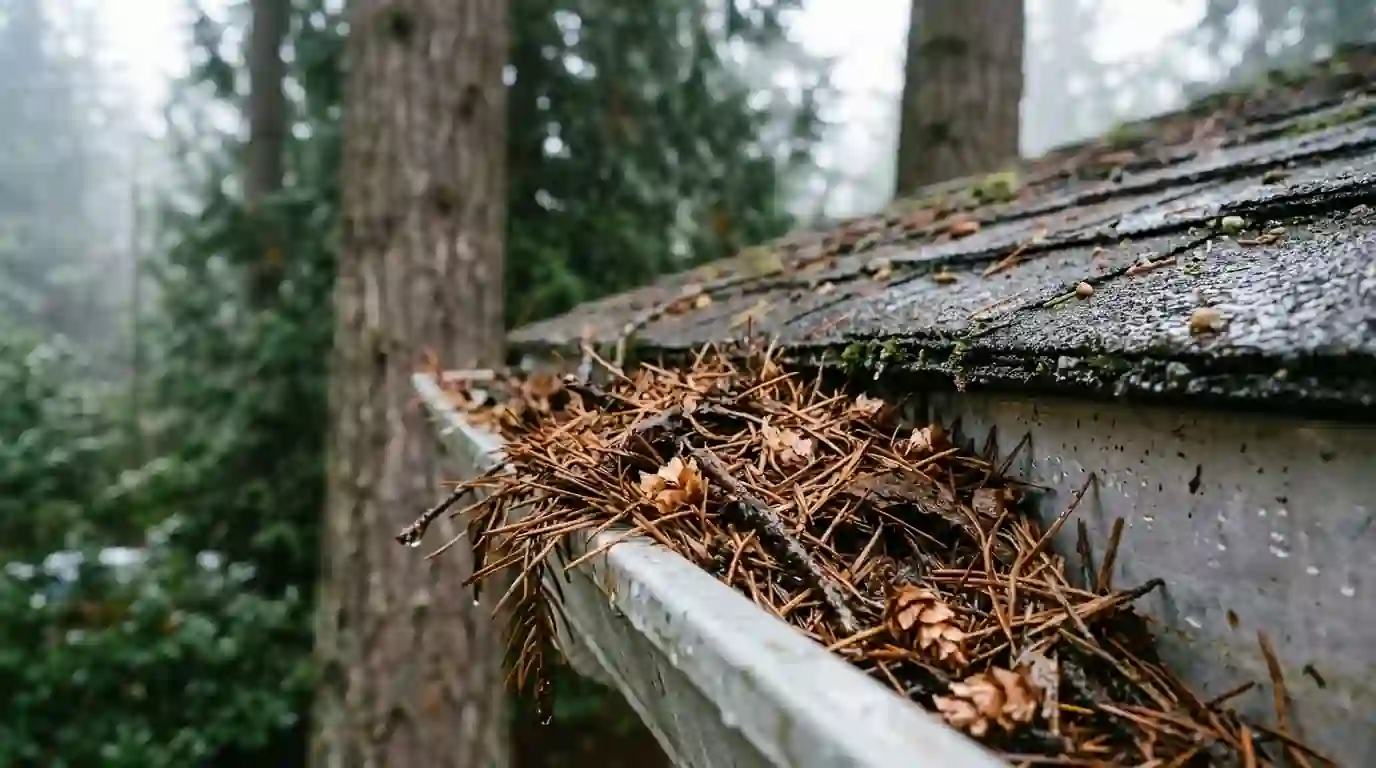
Tree cover is the other big factor. Homes in Southwest Hills, Lake Oswego and West Linn often sit under Douglas firs that drop needles all year, plus bigleaf maples that fill gutters in October. Larger downspouts pass needles more easily, and fewer elbows mean fewer spots for debris to jam. Gutter guards can be added once the system is up.
Why homeowners have us install their gutters
Formed to your eave lengths
We form gutters on site so each run is one piece from corner to corner. That means fewer joints to leak and a cleaner line along the roof edge.
Sized by the numbers
We measure roof area and pitch for each run instead of guessing, so the gutters and downspouts match the water they actually need to carry during heavy Portland rain.
Roofers who check the roof edge
Because we work on roofs every day, we check drip edge, fascia and the first course of shingles while installing gutters, and fix problems there before new gutters cover them.
Seamless Gutter Installation questions from Portland homeowners
Should my Portland home have 5 inch or 6 inch gutters?
Many Portland homes do fine with 5 inch gutters, but steep roofs, large roof sections, valleys that empty into one corner and homes under big trees usually need 6 inch. We measure the roof area and pitch draining to each run and recommend the size that will keep up during heavy rain.
How long does seamless gutter installation take in Portland?
Most Portland homes get new seamless gutters in one day. Large houses, three story homes or jobs that need fascia replacement can take two days. We schedule around dry weather when we can, though gutters can be hung in light rain if conditions are safe.
How many downspouts does a Portland house need?
A common rule is a downspout every thirty to forty feet of gutter, but roof area and pitch matter more than length. A steep roof or a valley pouring into one run may need an extra downspout. We place them where water can be carried safely away from the foundation.
Can seamless gutters handle Douglas fir needles in Portland?
Seamless gutters move needles better than sectional ones because there are fewer joints for debris to catch on. Using 6 inch gutters and 3 by 4 inch downspouts helps further. Under heavy fir cover, adding a gutter guard reduces how often you need cleaning.
Do you replace rotted fascia before installing gutters in Portland?
Yes. Hanging new gutters on soft fascia leads to sagging and pulled hangers. We check the boards when the old gutters come down, replace any rotted sections and paint or wrap them so the new gutters have solid wood to fasten into.
Where we do this work most
We cover the whole metro. These are the places we are on roofs most often:
Related roofing services
Gutter Guards
Not every gutter guard can stop Douglas fir needles. We fit Portland homes with guards matched to the trees overhead, so gutters keep flowing through...
Gutter & Downspout Repair
Leaking seams, sagging runs, hangers pulled out of the fascia and downspouts that dump at the foundation. We repair Portland gutters so they carry...
Fascia & Soffit Repair
Soft fascia behind the gutter, peeling soffit paint or birds nesting in the eaves usually means water has been getting past your roof edge. We...
Roof Maintenance
A regular tune-up keeps a Portland roof ahead of the rain. We clear debris, renew sealant, check every boot and flashing and flush gutters on a...
Need seamless gutter installation in Portland?
Call and tell us what you are seeing. We answer 24/7 and can usually talk you through the next step on the first call.