Pipe boot and roof vent repair in Portland
The rubber collar around a plumbing vent is often the first part of a Portland roof to fail, usually years before the shingles. Replacing a cracked boot is a small job that stops a surprisingly common leak.
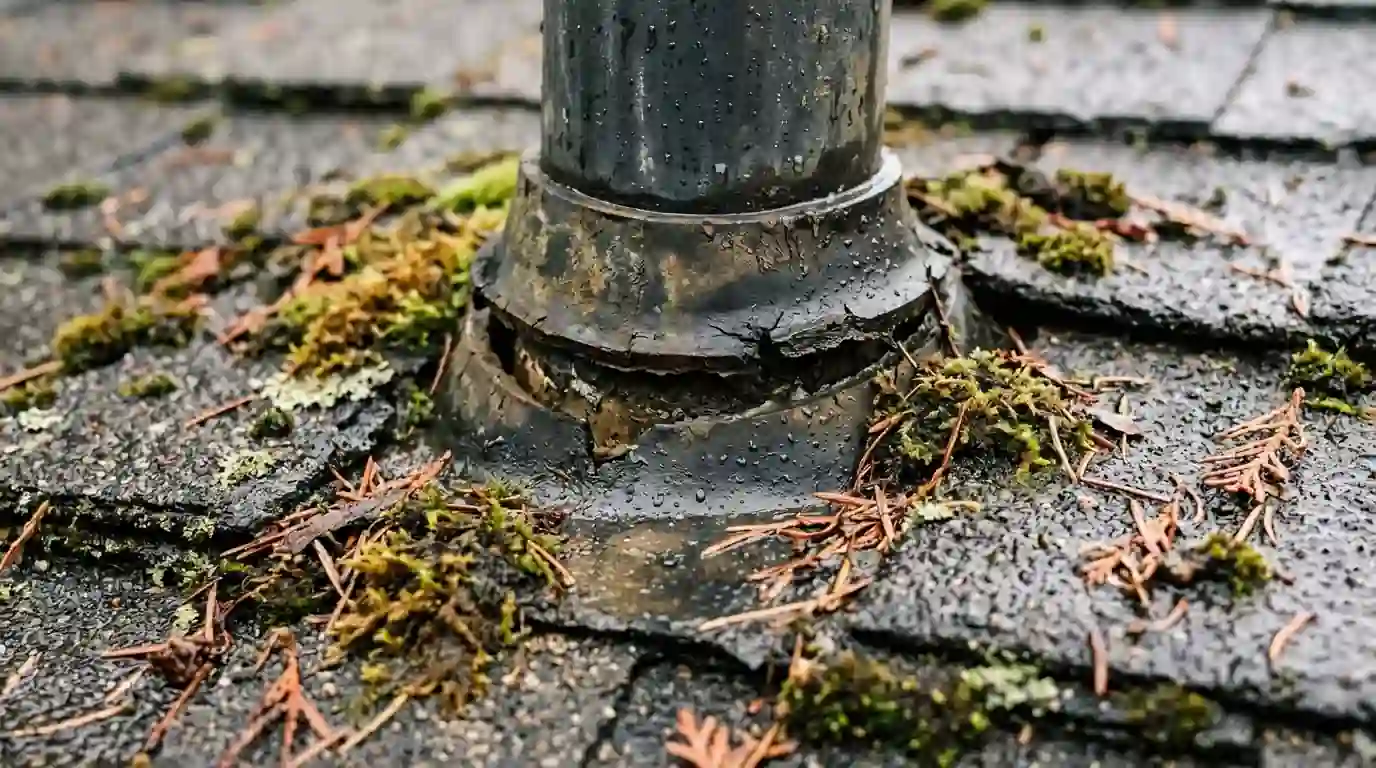
Pipe boot and vent repair in Portland usually costs $245 to $1,280. Rubber pipe boots crack after roughly 10 to 15 years of sun, letting water run down the vent pipe into the attic. We replace cracked boots, rusted or dented box vents, damaged exhaust caps and loose fasteners, setting each new part correctly under the shingles above. Call (503) 917-5484 to schedule a repair.
Every roof has penetrations: plumbing vent stacks, bathroom and kitchen exhaust caps, box vents for the attic, sometimes a furnace or water heater flue. Each one is a hole in the roof sealed by a flashing collar. The most common is the pipe boot, a metal or plastic base with a rubber collar that hugs the vent pipe. The base sits under the shingles above and over the shingles below, while the rubber seals the pipe itself.
That rubber is the weak link. After years of ultraviolet exposure and Portland's wet and dry cycles, it shrinks, hardens and cracks around the pipe. Rain then runs down the outside of the pipe and drips into the attic, often onto insulation where nobody notices for months. On many Portland roofs, the shingles have years left when the boots are already failing.
Other vents wear out in their own ways. Box vents rust or get dented by falling branches. Bath fan caps lose their dampers or come loose. Nail heads holding vent flanges back out and leave open holes. Each of these is a small repair, but together they account for a large share of the leaks we trace in Portland attics.
Pipe boot and vent options we install
The right replacement depends on the pipe size, the vent type and how long you want it to last.
Standard rubber pipe boot
A metal or plastic base with an EPDM collar. It is inexpensive and works well, but the rubber will need replacing again after 10 to 15 years in Portland sun and rain.
Silicone or high-grade boot
Upgraded boots with silicone collars resist UV and cracking much longer than standard rubber. They cost a bit more and often last as long as the shingles around them.
Lead or copper flashing
Soft lead or copper flashing folded over the top of the pipe lasts for decades and resists damage from animals. It suits older homes and cast iron stacks.
Replacement box and exhaust vents
Rusted or dented attic vents and bath fan caps are swapped for new units with intact screens and dampers, sized to match the existing opening and ventilation needs.
Signs a pipe boot or roof vent needs replacing
These problems are easy to spot from the attic or the roof once you know what to look for.
Cracked rubber around the pipe
Look closely at the collar around each plumbing vent. If the rubber is split, pulling away from the pipe or brittle, it is letting water down the pipe every time it rains.
Water stains around a vent pipe
In the attic, darkened wood or wet insulation right around a plumbing stack or exhaust duct is a strong sign the boot or cap above has failed.
Ceiling stain near a bathroom
Stains on a bathroom or hallway ceiling below a vent often trace to the pipe boot or bath fan cap above, even when the shingles look fine from the yard.
Rusted or dented box vents
Metal attic vents rust at the seams and get dented by limbs or ice. Holes or bent flanges let water and pests into the attic space.
Exposed nail heads on flanges
Nails driven through the face of a vent flange without sealing, or nails that have backed out, leave open holes right at the penetration.
Animals getting into the attic
Squirrels and birds sometimes chew or push through damaged vent screens and rubber boots. Gnawed collars or nesting material near a vent mean it needs replacing and screening.
How we replace pipe boots and vents so they stay sealed
Check every penetration on the roof
Even if one vent is leaking, the others are usually the same age. We inspect every pipe boot, exhaust cap and attic vent so you can fix them all in one visit instead of one leak at a time.
Lift shingles above the vent
We carefully break the seal on the shingles above the penetration and pull the nails, so the old flange can come out without tearing the surrounding roofing.
Remove the old boot or vent
The failed part comes out along with any old roofing cement. We check the decking around the hole for rot and replace any soft wood before installing the new part.
Install the new flashing correctly
The new boot or vent slides over the pipe or opening with its upper flange under the shingles above and its lower flange over the shingles below, so water runs over it, not under it.
Fasten and seal properly
Fasteners go under the upper shingle course where they are protected, and exposed nail heads are sealed. Shingles above are reinstalled and hand sealed back into place.
Confirm from the attic
We check from inside that the pipe and duct connections are sound and no daylight shows around the new flashing. Disconnected bath fan ducts are a common find, and we reconnect them while we are there.

Materials for pipe boot & vent repair come from manufacturers such as Malarkey, GAF, Owens Corning, CertainTeed, Carlisle and Velux, chosen for the job rather than the logo.
What pipe boot and vent repair costs in Portland in 2026
These are typical prices for replacing roof penetrations. Doing several at once usually lowers the cost per vent.
| Work | Typical Portland range |
|---|---|
| Replace one standard pipe bootper boot | $245 to $465 |
| Each additional boot same visitper boot | $115 to $215 |
| Silicone or lead pipe flashingper pipe | $335 to $635 |
| Box vent replacementper vent | $265 to $545 |
| Bath or kitchen exhaust cap replacementper cap | $295 to $585 |
These are general figures for vent work around Portland, not a quote. Your real price follows an on-roof look at every penetration and a written estimate.
What moves the price:
- Number of penetrations replaced
- Pipe size and material
- Roof pitch and access
- Rotted decking around the hole
- Boot type, rubber, silicone or lead
Why pipe boots and vents fail early on Portland roofs
Portland's climate is tough on rubber. Summers are dry and sunny enough to bake boots on south and west slopes, then eight months of rain and cold make the rubber swell and shrink. The result is cracking well before the shingles wear out. On many roofs we inspect in Beaverton, Tigard and Hillsboro, built in the 1990s and 2000s, the original boots have failed while the shingles still have years left.
Trees play a role too. Falling branches dent box vents and knock caps loose in neighborhoods with big canopy like Laurelhurst and the Southwest Hills, and moss can grow right up against a boot on a shaded north slope, holding water at the seal. Older homes in St. Johns and Arbor Lodge often have cast iron vent stacks, which need properly sized boots or lead flashing instead of standard plastic ones.
Why a careful boot replacement makes a difference
All penetrations checked together
Replacing every aging boot and vent in one trip saves you a string of separate leak calls over the next few winters.
Flashing tucked under shingles
We set the upper flange under the shingles instead of sealing it on top, which is the detail that keeps water flowing over the new boot.
Attic side looked at too
Checking ducts and pipes from inside catches disconnected bath fans and loose connections that can cause moisture problems on their own.
Pipe Boot & Vent Repair questions from Portland homeowners
How long do pipe boots last on a Portland roof?
Standard rubber pipe boots typically last 10 to 15 years in Portland before the collar cracks. Silicone and lead boots last much longer. South and west facing boots usually fail first because they get the most sun. If your roof is over 12 years old, it is worth having the boots checked.
Can I just caulk a cracked pipe boot instead of replacing it?
Caulk over a cracked boot may stop water for a season, but it hardens and pulls away just like the rubber did. Replacing the boot is inexpensive and fixes the problem properly. Rubber collar covers that slip over an old boot are another short-term option, though replacement lasts longer.
Why does my bathroom ceiling stain only in heavy Portland rain?
It is often the pipe boot or bath fan cap above. Small cracks let in water mostly during heavy or wind-driven rain. A disconnected fan duct can also drip condensation. We check the roof flashing and the attic duct to find which one is causing the stain.
Do you replace pipe boots during a roof inspection?
If we find cracked boots during an inspection, we can usually replace them on the same visit with your approval, since we carry common sizes. That avoids a second trip and stops the leak before it starts staining ceilings.
Should vents be replaced when getting a new roof in Portland?
Yes. Pipe boots, box vents and exhaust caps are inexpensive compared with the roof, and reusing old ones leaves the parts most likely to fail. On every Portland reroof we install new penetration flashing along with the shingles.
Where we do this work most
We cover the whole metro. These are the places we are on roofs most often:
Related roofing services
Roof Leak Repair
A stain on a Portland ceiling is rarely under the hole that caused it. We trace the water back along rafters and decking to the true entry point...
Attic & Roof Ventilation
Damp attics are common in Portland winters. We balance soffit intake with ridge or roof exhaust so moist air leaves the attic before it condenses on...
Roof Repair
Portland roofs rarely fail all at once. A few torn shingles, a cracked ridge cap or a soft valley can be fixed cleanly and matched to what you have...
Roof Inspection
A clear, photo-backed report on your Portland roof, for buying or selling a home, after a windstorm or before winter, with an honest read on how many...
Need pipe boot & vent repair in Portland?
Call and tell us what you are seeing. We answer 24/7 and can usually talk you through the next step on the first call.