Torch-down and modified bitumen roofing in Portland
Torch-down covers a huge share of older Portland flat roofs, from porch roofs on Craftsman homes to storefront buildings on Hawthorne. We install new two-ply systems and repair the ones already up there.
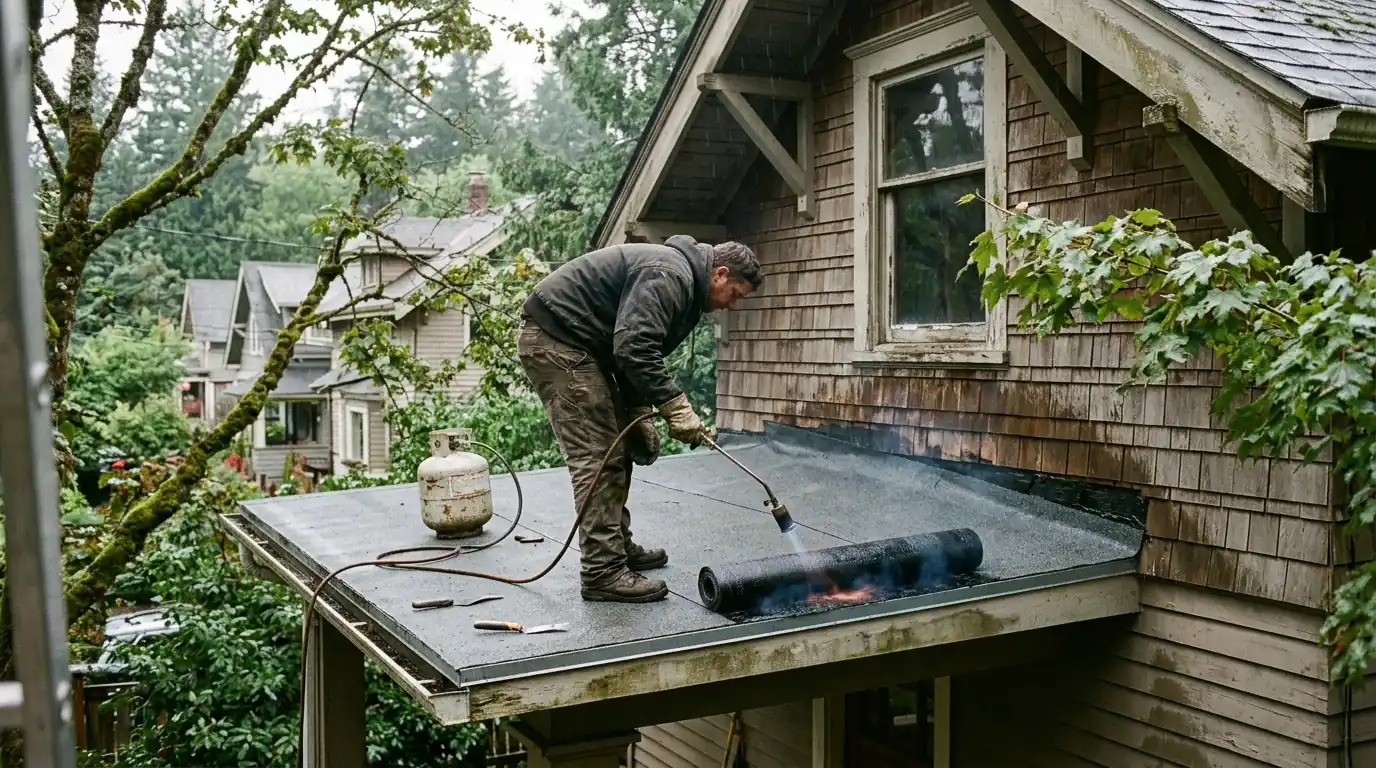
Torch-down roofing in Portland usually costs $9.60 to $15.80 per square foot for a new two-ply modified bitumen roof with tear-off, and $465 to $1,390 for typical repairs. The system uses a base sheet and a granulated cap sheet, with the cap melted onto the base using a propane torch so the layers fuse. It's tough, puncture resistant and well suited to small flat roofs that see foot traffic.
Modified bitumen is asphalt with rubber or plastic polymers mixed in, rolled into sheets with a reinforcing mat inside. In a torch-down system, a roofer heats the back of the sheet until the asphalt flows and presses it down so it fuses to the layer below. The result is a thick, multi-layer roof without the hot kettle tar of old built-up roofs.
Portland has a lot of it. Flat porch roofs over front entries, sleeping porches enclosed in the 1940s, flat roofed garages, and the hidden roofs behind parapets on older brick and wood storefronts are often torch-down or the built-up roofs that came before it. We replace worn systems with new two-ply modified bitumen and repair existing ones with matching base and cap material, including torch safety work around wood framing.
Which modified bitumen system suits your roof?
Modified bitumen comes in several forms, and the best choice depends on the building and how close flame can safely go.
Two-ply torch-applied system
A torched base and cap sheet fused together. It's the classic system on Portland flat roofs, very durable and puncture resistant. Best on open roofs with masonry parapets or noncombustible edges.
Self-adhered modified bitumen
Peel-and-stick base and cap sheets that need no flame. Ideal for porch roofs against wood siding, roofs under overhanging eaves and spots where torching would be unsafe. A little slower to install but very clean.
Hybrid torch and self-adhered
Self-adhered sheets near walls and edges, torched cap in the open field. This gives the strength of torched seams where it's safe and avoids flame in risky corners.
Reflective cap sheet
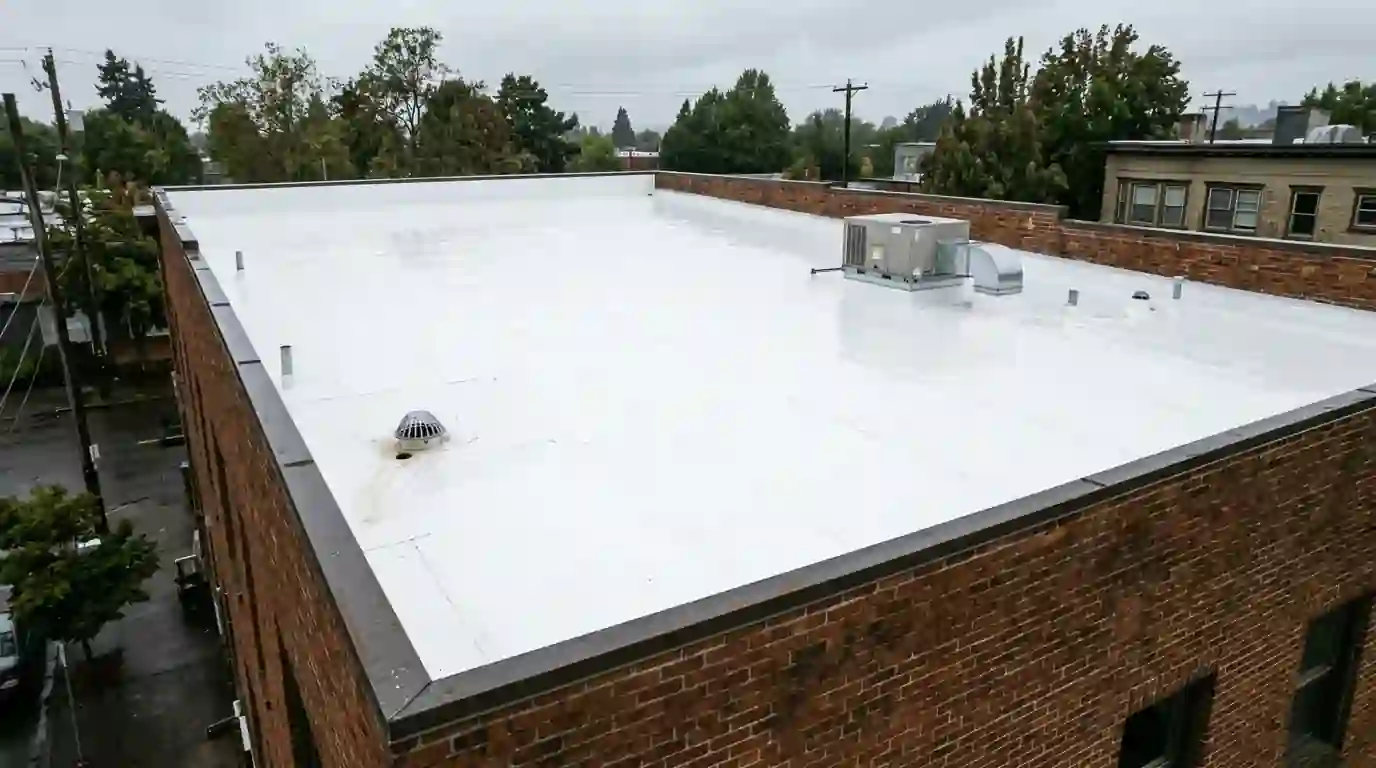
A white granulated cap sheet that reflects more heat. Useful on mixed-use buildings with apartments directly below the roof, where summer heat buildup is a comfort complaint.
What does a worn torch-down roof look like?
Modified bitumen shows its age in ways you can often spot from a window or a ladder.
Bare spots in the granules
The mineral granules on the cap sheet protect the asphalt from the sun. Once patches of black asphalt show through, that area dries out, cracks and starts letting water into the layers below.
Open laps at side seams
Where one roll overlaps another, the edge can lift as the asphalt ages. A lifted lap catches wind driven rain and channels it under the cap sheet toward the deck.
Blisters that crunch underfoot
Air or moisture trapped between plies expands in warm weather and forms bubbles. Small, intact blisters can be watched, but split ones open a direct path for water.
Cracked flashing at the house wall
On porch roofs, the joint where the roof turns up the house siding is the weak point. Cracks or gaps behind the siding let water run straight into the wall framing.
Dark staining on porch ceilings
Stains on beadboard or plaster porch ceilings are an early sign. Porch roofs often have no insulation, so water shows up quickly and rots the rafter tails and fascia.
Old patches stacked on patches
Layers of roof cement and mismatched patches show a roof that has been leaking for years. Each patch traps moisture, and eventually the whole surface needs to come off.
How we install and repair torch-down roofs safely
Remove the old roof
We strip existing cap sheets, felts and roof cement down to the deck. On porch roofs we often find 1x plank decking with gaps, which we overlay with plywood so the new base sheet has full support.
Set the base sheet
A base sheet is mechanically fastened or self-adhered to the deck. Where the roof meets wood framing or siding, we use self-adhered base so no open flame comes near combustible surfaces.
Torch the cap sheet
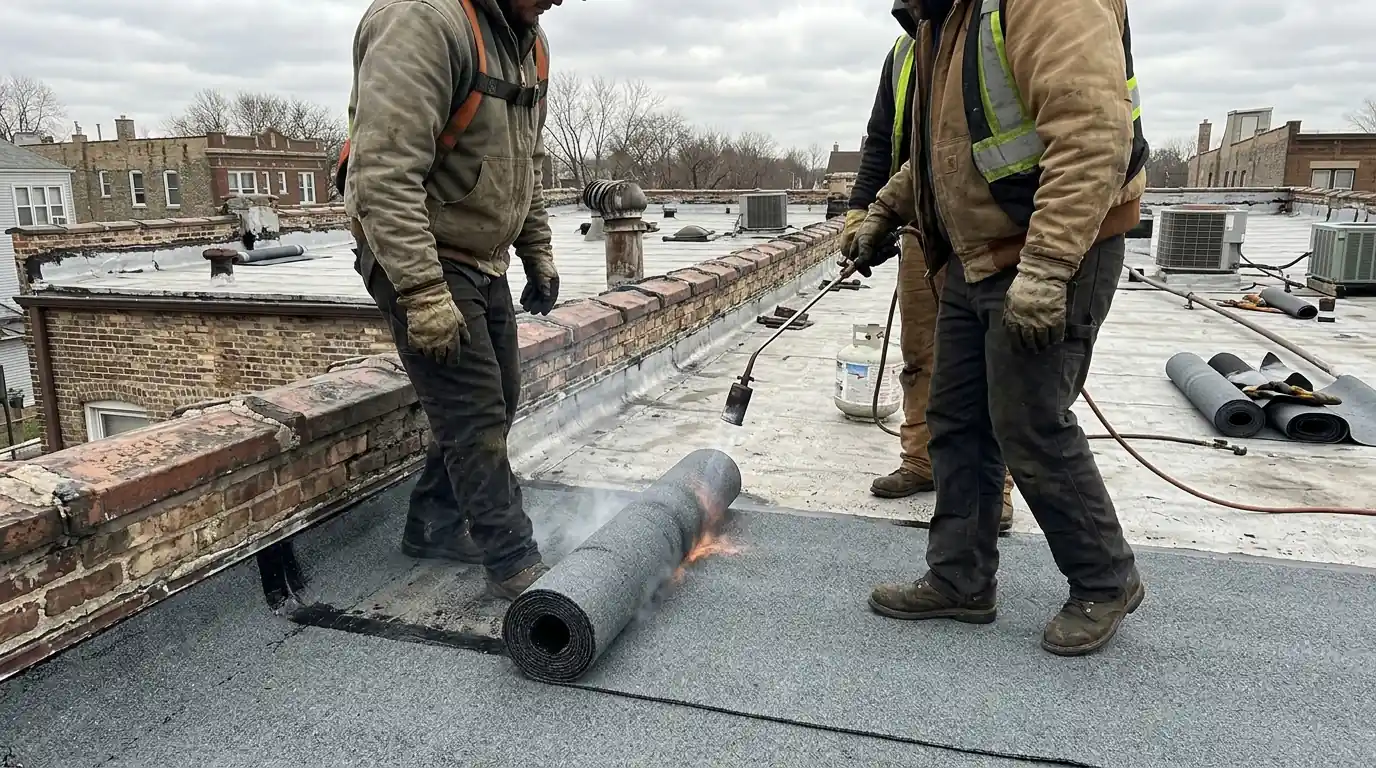
The granulated cap sheet is unrolled, heated along its back with a propane torch until the asphalt flows, and pressed into the base. We watch for a small bead of asphalt at each lap as a sign the layers fused.
Flash walls and edges
Base and cap plies turn up walls and parapets, then metal counterflashing or a reglet covers the top edge. Drip edge and gravel stop at the roof perimeter keep water off the fascia.
Fire watch before leaving
After torching ends for the day, a roofer stays on site and checks under edges, siding and eaves with a heat sensor. Smoldering materials can hide in cavities, so this step never gets skipped.
Seal laps and granulate touchups
Any seam where granules were disturbed gets loose granules pressed into the hot asphalt so the color matches and the asphalt stays protected from the sun.
Materials for torch-down & modified bitumen come from manufacturers such as Malarkey, GAF, Owens Corning, CertainTeed, Carlisle and Velux, chosen for the job rather than the logo.
How much does torch-down roofing cost in Portland?
Here are typical 2026 Portland ranges for modified bitumen work on homes and small buildings. Small porch roofs cost more per square foot because setup is the same regardless of size.
| Work | Typical Portland range |
|---|---|
| Two-ply torch-down with tear-offper sq ft | $9.60 to $15.80 |
| Self-adhered modified bitumenper sq ft | $10.40 to $16.30 |
| Porch roof replacement, smallper porch | $2,180 to $4,760 |
| Seam, blister or patch repairper repair | $465 to $1,390 |
| Wall flashing rebuildper wall section | $615 to $1,680 |
These are typical Portland ranges, not a quote. The real price comes after we look at your roof and hand you a written estimate.
What moves the price:
- Roof size and setup
- Torch, self-adhered or hybrid
- Layers of old roofing
- Decking and rafter tail repair
- Parapets and wall flashing
- Building height and access
Torch-down on Portland porches and mixed-use buildings
Craftsman and Foursquare homes in Irvington, Beaumont-Wilshire and Rose City Park often have flat or nearly flat porch roofs that drain toward a single corner. Fir needles collect there, moss grows in the granules, and water backs up against the siding. When we redo those porches, we add a slight taper and a proper edge so water drains off the front instead of pooling at the wall.
Along Alberta, Division and Hawthorne, two story mixed-use buildings with shops below and apartments above usually have torch-down or old built-up roofs behind parapets. These roofs see HVAC service traffic and sometimes residents stepping out of windows. Modified bitumen holds up to that use, and we can work in sections around tenants. In Concordia we see similar flat roofs on small corner buildings that were converted to homes.
What you should expect from a torch-down roofer
Flame used only where safe
We switch to self-adhered sheets next to siding, eaves and wood trim. Torching is reserved for open areas, and that judgment protects your home from the main risk this system carries.
Fire watch every day
A roofer stays after torching stops and checks hidden areas with a heat sensor. It adds time to each day, and it's the right way to run a torch-down job.
Porch roofs drained properly
We build slope and correct edges on porch roofs so water leaves the front, rather than pooling against the house wall where it rots framing.
Torch-Down & Modified Bitumen questions from Portland homeowners
Is torch-down roofing safe on older Portland wood homes?
Yes, when it's installed with care. On older wood homes, we use self-adhered base and cap sheets next to siding, eaves and trim, and torch only in open areas away from combustible surfaces. A daily fire watch with a heat sensor checks hidden spaces before we leave the site.
How long does torch-down last on a Portland porch roof?
A well installed two-ply modified bitumen porch roof commonly lasts 18 to 25 years here. Drainage makes the biggest difference. Porch roofs that pond against the wall age much faster, which is why we add slope and a clean drip edge when we replace them.
Can a torch-down roof in Portland be repaired instead of replaced?
Often, yes. Open laps, small blisters and localized cracks can be cut out and repaired with matching base and cap material torched or adhered in place. If granules are gone across most of the surface or the roof has several soft areas, replacement is usually the better use of money.
What is the difference between torch-down and built-up roofing in Portland?
Built-up roofing uses many layers of felt and hot asphalt or tar, often with gravel on top, and was common on older Portland commercial buildings. Torch-down uses factory made modified bitumen sheets fused with a torch. It's lighter, faster to install and more flexible in cold weather.
Can you walk on a torch-down roof in Portland?
Modified bitumen handles occasional foot traffic better than most low-slope membranes, which is why it's common on porch and mixed-use roofs. For roofs used often for HVAC service or as a deck, we add walkway pads or a separate decking system to protect the cap sheet.
Where we do this work most
We cover the whole metro. These are the places we are on roofs most often:
Related roofing services
Flat Roof Repair
Low-slope roofs in Portland hold water for months at a time. We find where it's getting in, repair the membrane, seams and drains, and get your flat...
Flat Roof Replacement
When a Portland flat roof has more patches than original membrane, it's time to start over. We strip it to the deck, fix the drainage and install a...
Commercial Roof Repair
A drip over a register, a server room or a stack of inventory can't wait. We respond to commercial roof leaks around Portland, stop the water, and...
Apartment & Multifamily Roofing
Roof work on Portland apartments, condo buildings and fourplexes, planned around tenants, parking, board approvals and the wet season so residents...
Roof Flashing Repair
Most roof leaks in Portland start at a joint, not in the open field of shingles. Flashing at dormers, sidewalls, valleys and roof edges is where...
Need torch-down & modified bitumen in Portland?
Call and tell us what you are seeing. We answer 24/7 and can usually talk you through the next step on the first call.