Shingles need pitch to shed water. On a porch roof, a rear addition, a garage or the roof of a mixed-use building along a commercial street, there often isn't enough slope for shingles to work. Those roofs need a membrane: a continuous waterproof layer that can handle water sitting on it for hours. Around Portland, three membranes cover most of these jobs: TPO, torch-down modified bitumen and EPDM rubber.
Each has strengths. Choosing between them depends less on which is best in general and more on the roof you have: its size, how it drains, how much foot traffic it gets, what's mounted on it and how it ties into walls and sloped roofs. Below we compare them the way we would on site, with typical 2026 Portland pricing.
What makes low-slope roofs so demanding in Portland?
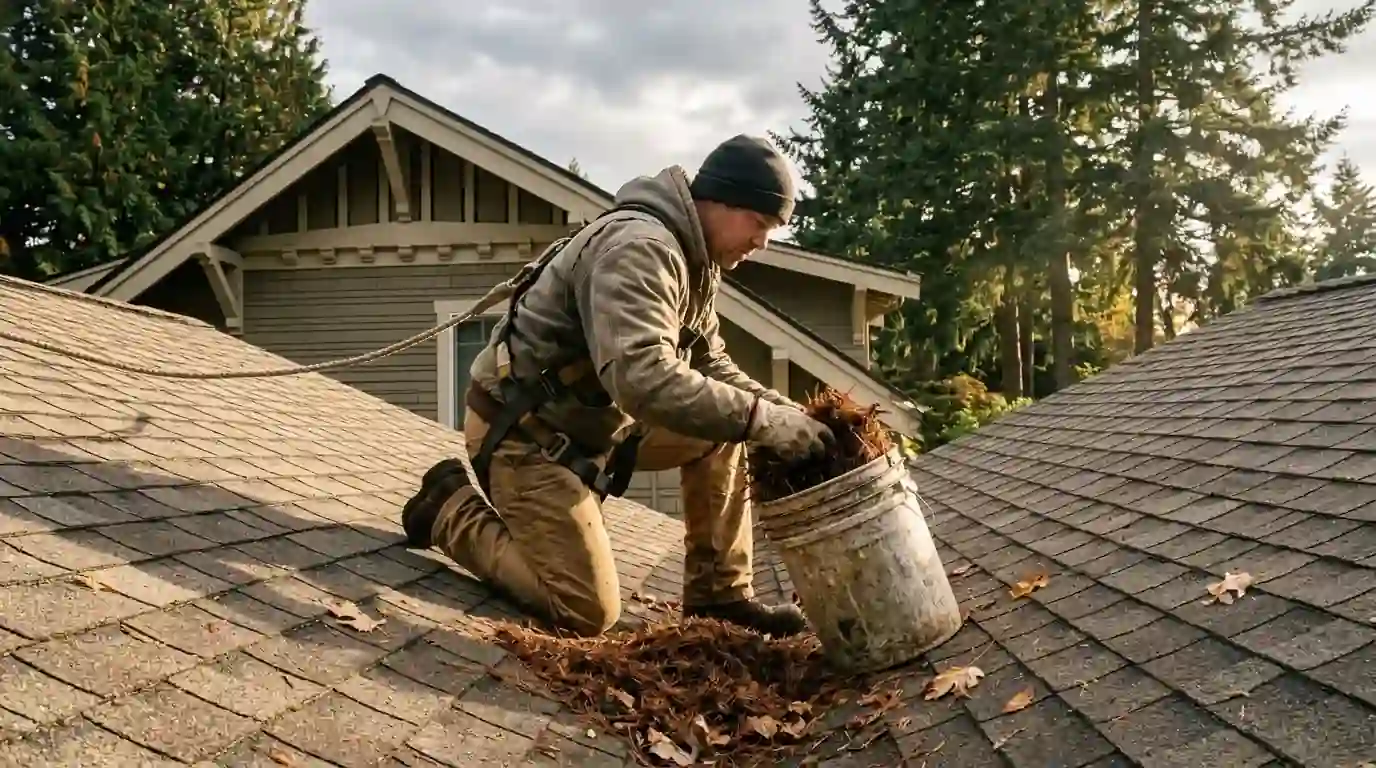
A low-slope roof drains slowly by design. In a dry climate, a little ponding after a storm evaporates in a day. Here, rain can fall for a week with only short breaks, so water and wet debris sit on these roofs far longer. Fir needles and maple leaves collect around drains and scuppers, moss grows on any granular surface in the shade, and every seam spends much of the winter under water.
The weak points are almost always the same: seams between sheets, the edges where the membrane meets a wall or parapet, penetrations for vents and HVAC equipment, and drains or scuppers that clog. A good low-slope roof is mostly about getting those details right, whichever membrane you choose. A cricket or tapered insulation that moves water toward drains matters just as much as the membrane.
Where does TPO make the most sense?
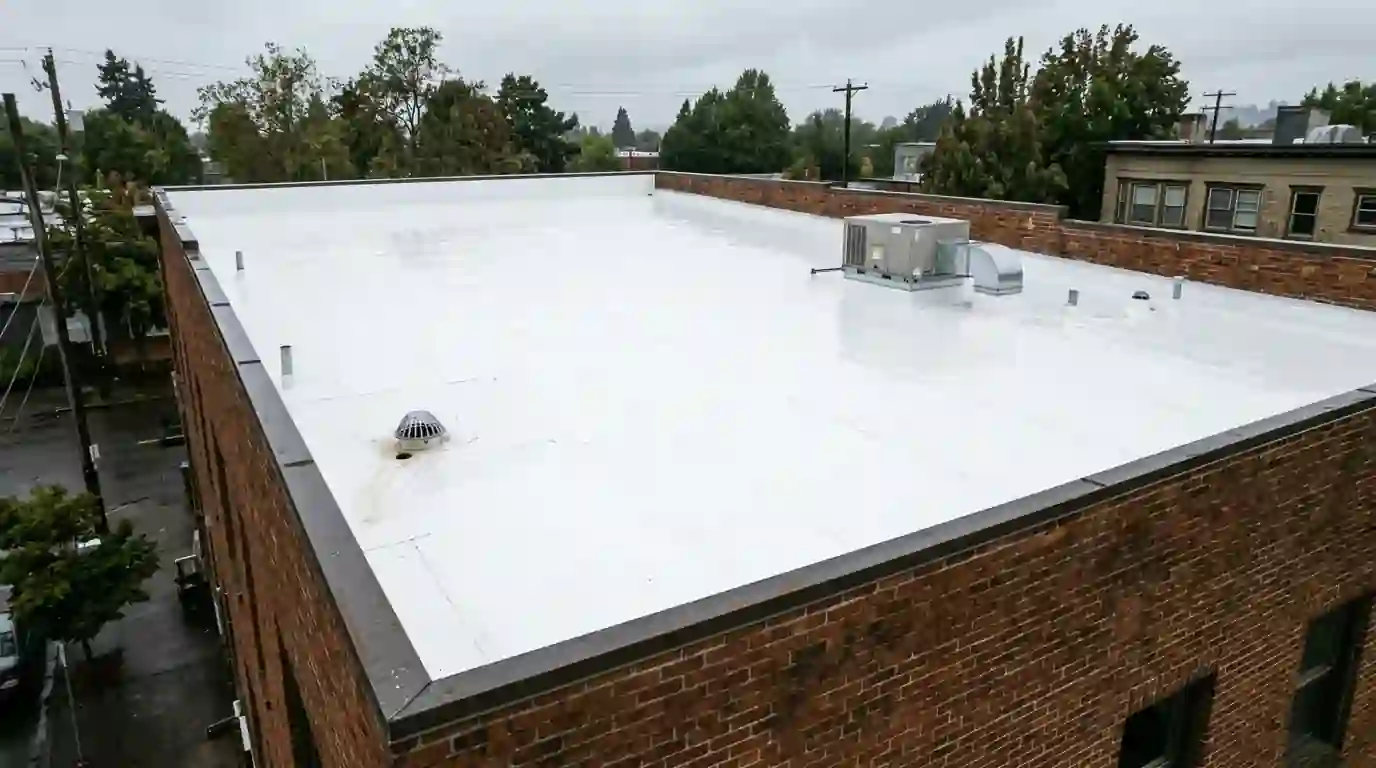
TPO is a single-ply thermoplastic membrane, usually white, that comes in wide rolls. Its seams are heat-welded with a hot-air tool, which fuses the sheets into one continuous layer. A properly welded seam is as strong as the sheet itself, and that's TPO's biggest advantage on roofs where water sits.
The white surface reflects sunlight, which keeps top floor units cooler in summer on mixed-use buildings and apartments. TPO from makers such as Carlisle, Versico and Firestone is common on larger commercial roofs and works well on additions and garages too. It's lightweight and goes on over insulation board, which lets us improve drainage and energy performance at the same time.
TPO needs careful detailing at corners and penetrations and a crew comfortable with heat welding. It's slippery when wet, so roofs with regular foot traffic often get walkway pads.
Why choose torch-down modified bitumen?
Torch-down is a modified bitumen system, typically a base sheet and a granulated cap sheet, with seams melted together using a torch. It's been common on Portland porches, flat dormers and older commercial buildings for decades, and many roofers and inspectors know it well.
Its strengths are toughness and familiarity. The two-ply system stands up to foot traffic, the granulated surface resists punctures and UV, and it ties in neatly with sloped shingle roofs at the transition. On small porch roofs and additions where a shingle roof meets a flat section, torch-down often makes the cleanest detail.
The tradeoffs are a darker surface that absorbs heat, a granule surface that can grow moss in shade, and the torch itself. Open flame needs care near wood trim, siding and old framing, so on some buildings we use self-adhered modified bitumen sheets instead, which go on without a flame.
Is EPDM rubber still a good option?
EPDM is a synthetic rubber membrane, usually black, that comes in large sheets. On smaller roofs it can often go down in a single piece with no field seams at all, which removes the most common leak point. Where seams are needed, they're joined with seam tape and primer rather than heat.
EPDM handles temperature swings well, stays flexible in cold snaps and is relatively easy to repair. It's a good fit for simple roofs with few penetrations, such as a garage, a rear addition or a small commercial building. Its weaker spots are seams and flashings, which depend on careful adhesive work, and the dark surface, which absorbs summer heat unless a coating is added.
How do the three compare side by side?
Here's a quick summary of how each membrane fits common Portland situations, with typical 2026 installed ranges. These are typical figures and not a quote; the real price comes after we've looked at the roof and put the scope in a written estimate, including any tear-off, insulation and decking repairs.
- TPO, heat-welded seams, reflective: $9.40 to $14.70 per square foot, best for larger roofs, mixed-use buildings and roofs with ponding concerns
- Torch-down two-ply modified bitumen: $8.65 to $13.80 per square foot, best for porches, flat dormers and shingle tie-ins with foot traffic
- EPDM rubber: $8.20 to $12.90 per square foot, best for simple garages and additions with few penetrations
- Small porch roof replacement of any membrane: $1,860 to $4,730 depending on size and access
What details matter more than the membrane itself?
We've repaired plenty of low-slope roofs that failed with a perfectly good membrane, because the details around it were wrong. On every flat or low-slope job, these items get as much attention as the membrane choice:
- Drainage: tapered insulation or crickets that send water to drains and scuppers instead of letting it pond
- Edges: metal edge flashing and termination bars that hold the membrane tight at walls and parapets
- Penetrations: prefabricated boots or properly flashed curbs for every pipe, vent and HVAC unit
- Transitions: clean tie-ins where a flat porch roof meets the main shingle roof or a wall
- Decking: replacing soft or rotted boards before the new membrane goes on, since wet decking won't hold fasteners or adhesive
How do we pick the right system for your building?
We start by looking at what's there now and why it failed, if it did. We check drainage, the condition of the deck and insulation, how many penetrations there are and how people use the roof. On mixed-use buildings, we also consider rooftop equipment, access for service crews and how work will affect tenants below.
Then we recommend the membrane and detailing that fits, explain why and price it in writing. If you have a porch roof that leaks every winter, an addition with ponding water or a commercial building that needs attention, call (503) 917-5484. We answer 24/7.
Key takeaways
- Low-slope roofs in Portland sit wet for long stretches, so seams, edges and drains matter most.
- TPO's heat-welded seams and reflective surface suit larger roofs and mixed-use buildings.
- Torch-down is tough under foot traffic and ties neatly into shingle roofs on porches and dormers.
- EPDM works well on simple roofs where it can go down with few or no seams.
- Good drainage and detailing prevent more leaks than the choice of membrane.
Written and edited by Grady Pelham, Roofing Articles Editor at MY Construction Roofing. Last updated August 6, 2026.